What is a digital customer journey and how can I use it in my marketing?
A customer journey is the path a customer takes from the first contact with a company to a purchase and on to becoming a returning customer. It describes all the touchpoints along the way, such as searches, the website, newsletters, the purchase and follow-up.
The art of sparking interest and building and nurturing relationships is largely about timing and relevance. It is about using your communication to meet customers based on their interests and where they are in the customer journey, and to help them through the process. You achieve this by making use of email and marketing automation. Email is the channel most people prefer for communicating with brands and companies. It is also a cost-effective channel with a high ROI (return on investment). Automation is what takes your email marketing to the next level, where you work in a data-driven way and let your channels work together to reach your goals. This guide gives an overview with some examples and tips, whether you market to consumers or to businesses.

The customer journey – the foundation of all marketing
A well-planned customer journey helps you understand how your customers move from first contact to loyalty. By mapping the different steps of the customer journey, you get a clearer picture of what questions customers ask, what content they are looking for and what communication builds the most trust. Working with the customer journey in a structured way means you can meet customers with the right message in the right channel at the right time.
Contents:
👉 Customer journey phases👉 Awareness
👉 The customer journey in B2C and B2B
👉 Get started with Paloma marketing automation
How to map the customer journey
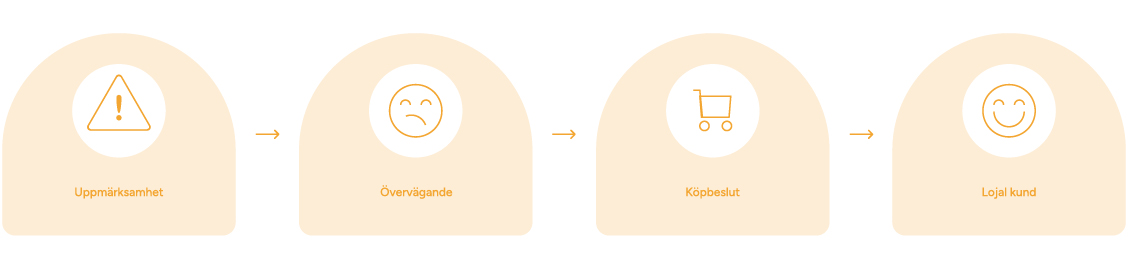
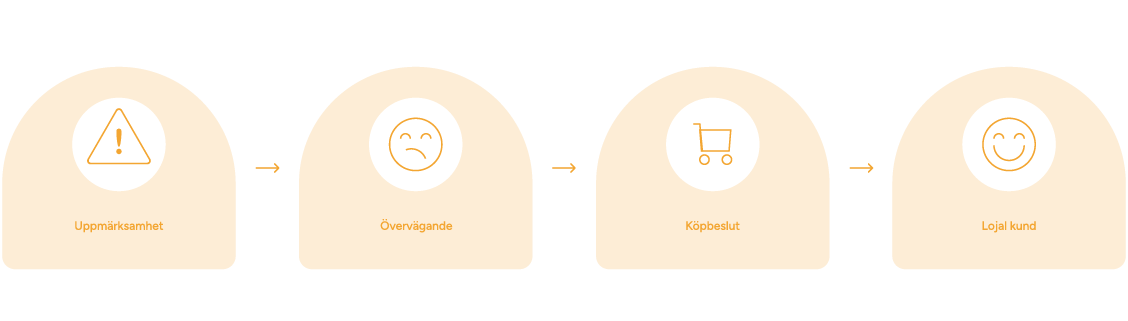
Mapping the customer journey means identifying all the touchpoints between your company and the customer. It can be anything from a Google search to a meeting at a trade fair. By writing down the phases of the customer journey – awareness, consideration, purchase decision and loyalty – it becomes easier to create a strategy that reduces friction and strengthens the relationship. Once you understand the customer journey, it also becomes easier to see where automation and newsletters can contribute most. We will soon go through what type of communication can suit the different phases of the customer journey. But first, a reminder to build your contact list for sending newsletters. Take every natural opportunity to offer a subscription to your newsletter: on your website and on social media, in order and delivery confirmations, in your email signature and so on. Briefly describe what value the newsletter offers and how often it comes out. Create different types of welcome emails depending on where in the customer journey the prospect or customer is. You will find more on collecting email addresses, with more tips, in our Guide to better newsletters.
The awareness phase of the customer journey
In the awareness phase, the goal is to spark interest and engagement in the potential customer.
Lead visitors to your website
The hub of the digital customer journey is your website. First and foremost, make sure it has good structure and content, so that it is both accessible and appealing to visitors. Make it easy for visitors to take the next step, whether that means making a purchase, filling in a form or getting in touch. A/B test different landing pages and CTA buttons to see what best captures the attention of your target audience. Also make sure your website is mobile-friendly and uses responsive design – more and more interactions happen on mobile, especially in B2C.
To help visitors find and click through to your website, you can work with, among other things:
- SEO
- Google Ads
- Shareable content
- Traffic-driving posts and ads on social media.
Be interesting and generous
You can offer visitors to your website interesting information, for example a white paper or an infographic as a PDF, or a special offer, in exchange for their email address and a few other details about themselves in a form. In a welcome email, you can lead the recipient to your website with links to interesting content or current offers. This is also an opportunity to branch the automated flow depending on whether or not the recipient clicked a link.
Customer data and segmentation
Use both the data collected at registration, such as the postal code, and the data the automated flow collects, such as which link a recipient clicked. You can set up your flow so that a recipient who clicks a certain link is added to a certain contact list. That way, you can target communication and offers and increase the chances of getting the recipient where you want them.
The consideration phase of a customer journey
Optimize the customer journey with the right content.
The consideration phase is often where it is decided whether the customer moves on toward a purchase decision. Here you can optimize the customer journey by offering content that builds trust. Case studies, guides, reviews and relevant email campaigns make customers feel confident in their choice. The more you can tailor your communication based on data, the smoother the customer journey and the higher the conversion.
Once you have sparked a potential customer's interest, the next step is to get them hooked on your brand and what you offer. Keep in mind that the content in this phase should both inform and inspire trust – feel free to use case studies, ratings and reviews from previous customers. This is also a good time to test personalized recommendations based on previous interactions on your website or in email.
Helpfulness & added value
Here, helpfulness and added value are the key words. An example of what a flow for the consideration phase could look like:
The flow is triggered when a visitor downloads or orders a product catalog from your website.
An email is sent: Thank you for downloading our catalog. If you have any questions or thoughts, you can always contact us.
Later, another email is sent: Here are some tips on how you can use our products to xx. We also share our knowledge about xx.
If the recipient has still not returned to the website, yet another email is sent: Have you had a chance to look at the catalog? We hope you found something that inspires you. Now we have a really good offer for you: xx at the price of xx.
The purchase decision phase of the customer journey
When the potential customer takes the step and makes a purchase, the experience around it is important.
Transactional emails
Design transactional emails with care, so that the customer feels appreciated and looked after. Reinforce the sense of security in the purchase process by offering clear information about the terms for shipping, returns and warranties – it reduces friction at the purchase decision.
Involvement
If you are organizing an event, remember that the communication beforehand is part of the participant experience. Create a welcome email for those who have bought tickets, with information and teasers. Make it interactive for a greater chance of capturing attention and creating appreciation and engagement. Add clickable links, video clips and animated graphics.
Customer surveys & reviews
Follow up events, product purchases and more with a customer survey or a request to leave a review. It not only gives you valuable feedback and reviews to show off, it is also a way to show commitment to the customer experience. If you offer something in return, such as a discount code, you increase the chances of getting both reviews and more purchases.
The loyal customer phase of the customer journey
The customer journey as a tool for loyalty. A customer journey does not end at the purchase – on the contrary, that is when the most important part begins. By continuing to map the customer journey after the purchase, you can build long-term relationships. Here, personalized mailings, loyalty programs and recurring valuable content become central. A well-designed customer journey means that customers not only stay but also recommend you to others. You nurture established customer relationships through continued, regular mailings based on interests and purchases. It is also about continually offering that little bit extra. In this phase, you can also aim to turn the customer into a brand ambassador.
Showing appreciation
Acknowledge and celebrate the customer's birthday and the anniversary of when they became a customer with a personal email and a gift or an offer.
Reminders
Add reminder emails to your flows, directly or indirectly linked to your products and services. For example, remind customers that it is time to order more consumables, put away the winter tires or order in time for delivery before Christmas Eve.
Ask for feedback & help spreading the word
Now you can take it a step further and ask for more detailed feedback on how the customer experiences everything from your range to your service, and for suggestions for improvement. You can also ask customers to recommend you to friends and family who they think would also benefit from becoming customers. With a gift as a thank-you for their help, of course.
The customer journey in B2C and B2B
Differences between the customer journey in B2B and B2C
Even though the basics of a customer journey are the same, the steps look different in B2B and B2C. In B2C, the customer journey is often faster, with more emotionally driven decisions and shorter paths from inspiration to purchase. In B2B, the customer journey is longer and more complex, with several decision-makers involved and each step requiring more information and trust-building communication. Understanding these differences is crucial to creating a customer journey that works in your industry.
What the conditions for the customer journey look like, and therefore how your marketing should be designed, differs to some extent depending on whether the company targets consumers (business to consumer) or other companies (business to business). At the same time, the playing field has changed, not least with digitalization, and B2B has a few things to learn from B2C.
What characterizes B2C?
In B2C, transactions between company and customer are often direct, without complex decision-making processes before the purchase. The transition between the different phases of the customer journey can therefore be relatively quick. So if you have caught the customer's attention at the right moment, you have come a long way. Perhaps your content answered the customer's search query on Google, or you advertised to the right target audience at the right time.
The touchpoints with the brand are often not physical, and it is very important to build the brand with visual means. Customers in B2C also often define their identity in relation to the brand, which is why identification with the target audience and the feeling you convey become very important.
Keep this in mind
→ Make the most of every interaction with the customer, and respond with relationship-building communication.
→ Make sure you communicate consistently and uniformly in all channels, but vary the content. A subscription to your newsletter should pay off for the customer, and it will not if exactly the same content and offers are published on Facebook.
What characterizes a customer journey in B2B?
In B2B, the decision-making process is often more complex, with several people involved and a bigger step between consideration and the purchase decision. Here it is about making the process easier and focusing on which problems your offering solves, and how. A long-term perspective is important, and relationships are in focus.
Marketing activities at physical events such as trade fairs, conferences and training courses can be linked to activities in the digital channels – for example by encouraging visitors at physical events to click through to your website or follow you on social media, and by letting the marketing, coverage, reporting and follow-up of the event create content for your newsletter, among other things.
Customer journeys in B2B are harder to streamline than in B2C. Some customers may have special needs that require different processes. When you map the customer journey, it is then smart to divide it into two or more types, with different degrees of complexity.
By using features to score leads based on, for example, email opens and clicks, you can also let your automated flows support the sales department.
Keep this in mind
→ Even if you are targeting companies and more than one person will be involved in the decision-making process, it is individuals who read your emails and other communication. Do not be too impersonal, and address the reader directly as much as possible.
→ As consumers move more quickly between work and private life, our expectations in our contact with brands and companies are becoming more alike than before. That requires a greater focus on the customer and the customer experience in B2B. Think from the outside in, and get to know the target audience, their needs and problems. Work in a data-driven way and use automation to guide the customer journey. More about lead management in What is marketing automation?
Finally: 30 tips for creating a good customer journey
We finish with 30 tips for creating a good customer journey for your marketing and sales:
- Define your target audience Understand who your customers are and what they need. Create detailed personas to target your marketing better.
- Identify the customer's problems and needs Find out what problems your customers face and how your company can solve them.
- Create a positive first contact Make a good first impression by offering useful information and helpful service from the very start.
- Use several communication channels Be present on different platforms such as social media, email, phone and in-person meetings to reach your customers in different ways.
- Use storytelling Tell a story that engages your customers and creates a strong emotional connection to your brand.
- Offer personalization Tailor your message and your marketing to each customer's needs and preferences.
- Build trust Be honest, transparent and reliable in your communication to build trust with your customers.
- Offer exceptional customer service Be responsive, quick and helpful in your replies, and make sure your customers feel well looked after.
- Engage on social media Be active in relevant social media channels and use them as tools to engage and communicate with your customers.
- Offer useful and relevant content Create and share content that is relevant to your customers and that solves their problems or meets their needs.
- Use automation Automate certain processes, such as email marketing and follow-up, to streamline and personalize your customer journey.
- Give incentives for repeat purchases Offer loyalty programs, discounts or special offers to encourage customers to keep buying from you.
- Follow up Make sure you stay in touch with your customers even after they have made a purchase. Create a follow-up plan to ensure customer satisfaction and keep the relationship.
- Be available Make it easy for your customers to reach you when they have questions or need help.
- Offer a seamless buying experience Simplify the purchase process and minimize friction to make it easy for customers to buy from you.
- Use social proof Show positive reviews or testimonials to build trust and increase the credibility of your brand.
- Encourage user-generated content Ask your customers to share their experiences and photos related to your brand on social media, and use this as a marketing tool.
- Be responsive to feedback Listen to your customers' feedback and act on it to improve your product or service.
- Offer an easy return policy Make it easy for customers to return products or get a refund if they are not satisfied.
- Use influencer marketing Work with influencers who have followers in your target audience to reach new potential customers.
- Offer added value Give your customers something extra, such as a free guide or training that helps them get the most out of your product or service.
- Be consistent Make sure your message and tone of voice are consistent across all your marketing channels to build recognition and credibility.
- Measure and analyze Carefully follow up your marketing efforts and sales results to identify what works and what needs to be improved.
- Create a user-friendly website Make sure your website is easy to navigate and that important information is easily accessible to your customers.
- Offer exclusive events or experiences Organize events or provide unique experiences for your customers to create strong bonds and loyalty.
- Educate your customers Give your target audience knowledge and training in your field to establish yourself as an authority in the industry.
- Be socially responsible Show that your company cares about society and supports charities or environmental initiatives.
- Build partnerships Work with other companies in your industry to reach new customers and create synergies.
- Make sure your staff are customer-oriented Train your employees in customer service and make sure they understand the importance of offering a positive customer experience.
- Be flexible and adaptable Be ready to adjust your marketing strategy and customer journey based on customer feedback and changes in the market.
We hope these tips help you create an outstanding customer journey.
You might also be interested in reading about:
👉 How to create leads with lead generation
👉 Marketing automation – a comprehensive guide
👉 More about CTAs – calls to action
Why the customer journey is crucial for digital marketing
Companies that actively work to understand and improve the customer journey have a better chance of increasing both conversion and customer satisfaction. By seeing the customer journey as a whole, it becomes clear where to focus your marketing and which channels are most effective. Marketing automation is one of the most powerful tools for automating, measuring and optimizing the customer journey – and thereby creating more relevant and profitable communication.
Frequently asked questions about the customer journey
What is a customer journey?
A customer journey is the path a customer takes from first discovering a need or a company to a purchase and on to becoming a returning, loyal customer. It describes all the touchpoints along the way, such as searches, the website, newsletters, the purchase and follow-up.
What is meant by a digital customer journey?
A digital customer journey is the part of the customer journey that takes place in digital channels: search, the website, social media, email and SMS. Since every step leaves data, it can be measured and improved.
What phases does a customer journey have?
The customer journey is often divided into four phases: awareness, consideration, purchase decision and loyalty. In each phase, the customer has different questions and needs different content.
Why is the customer journey important?
When you understand the customer journey, you can deliver the right message at the right time, see where customers drop off and put your resources where they do the most good. That gives a better customer experience and more returning customers.
How do you map a customer journey?
Start from a clear target audience. List all the touchpoints from the first search to the follow-up after the purchase, and note what the customer wants to know at each step. Use data from your website, newsletters and customer surveys to see where customers get stuck.
What is the difference between the customer journey in B2B and B2C?
In B2B, the decision often takes longer and more people are involved, so the content needs to build trust over time. In B2C, things move faster, and feelings, price and simplicity carry more weight.
How can newsletters and SMS support the customer journey?
Welcome emails, reminders and follow-ups can be sent in the right phase of the customer journey. In Paloma, you bring together newsletters, SMS and automated flows in one tool. You can start with a free newsletter account, with up to 250 emails a month.
Get started with the customer journey with Paloma marketing automation
Want to make use of marketing automation? Paloma has developed a tool where you can easily and intuitively set up automated flows for marketing and customer communication that support your customer journey.
✓ Save time with a smart tool ✓ Set up automated flows
✓ Create forms and mailings
✓ Collect data and segment
✓ Reach out with personalized communication
✓ Automate digital lead generation
✓ Increase customer satisfaction and win new customers.
Get started with Paloma
Create your first newsletter in minutes. The free account gives you 250 emails a month with an unlimited number of contacts.
Create a free account