Email marketing 2026 – the complete guide for businesses
Email marketing is a digital marketing channel where businesses send emails, such as newsletters and campaigns, to a list of recipients who have given their consent. It is still one of the most cost-effective channels in digital marketing: according to the Litmus State of Email Report (2024), email marketing returns on average about 36 SEK for every 1 SEK invested.
You get started by collecting recipients, creating an email in a tool, segmenting, sending and following up on the results. In 2026, hyper-personalization, AI-driven subject lines and stricter delivery requirements (DMARC, BIMI) are the clearest shifts to adapt to. In this guide, we go through everything you need to know to succeed: from the basics of strategy to how to avoid the most common mistakes. Want to start sending right away? With Paloma's newsletters, you create, send and follow up professional emails.

What is email marketing?
Email marketing is a digital marketing strategy where businesses send targeted emails, such as newsletters, campaigns and automated emails, to a list of subscribers who have given their consent. The purpose is to build relationships, share news and drive sales.
Email marketing is one of the oldest forms of digital marketing, but also one of the most alive. Even though social media and messaging apps have taken over large parts of our communication, email is still the channel where you own the relationship with your recipient yourself. No algorithm decides whether your emails are shown.
The most common forms of email marketing
- Newsletters: recurring emails with content that interests the recipient
- Campaign emails: time-limited offers or launches
- Welcome emails: the first impression when someone subscribes
- Reminders: before events, meetings or deadlines
- Automated flows: emails triggered by the recipient's behavior
- Transactional emails: order confirmations, receipts, shipping information
What is a bulk email?
A bulk email is an email sent to many recipients at the same time, for example a newsletter, a campaign or information to customers. To manage recipient lists, design and statistics, businesses usually use a tool for sending email.
Why does email marketing work so well?
Even though the channel is old, it is still one of the most effective for Swedish businesses. There are a few clear reasons:
You own the relationship. Unlike social media, your email list is entirely yours. No algorithm change can suddenly halve your reach.
High return. According to the Litmus State of Email Report (2024), email marketing returns on average about 36 SEK for every 1 SEK invested, far more than most other digital channels.
Measurable in detail. You see exactly who opened, clicked and converted, and can improve every email.
Direct contact. The email lands in the recipient's own inbox, often within minutes.
Scalable. It costs roughly the same to reach 100 as 100,000 people.
Truly personal. With segmentation and automation, every recipient can get an email that feels tailor-made.
This makes email marketing one of the few channels where small and medium-sized businesses can compete on equal terms with the big ones. Good content and an engaged list beat a big budget.
Different types of email – when do you use what?
There is no one-size-fits-all solution. Different types of email suit different purposes, and a successful strategy combines several. Here are the most common:
| Type of email | Purpose | Frequency | Example |
|---|---|---|---|
| Newsletter | Build relationships, inform | 1 to 4 times a month | A monthly newsletter with tips and news |
| Campaign | Drive sales | As needed | Black Friday, a launch |
| Welcome email | Onboarding | Automatic | Greet new subscribers |
| Reminder | Secure attendance or a response | Before an event or deadline | Before a webinar or meeting |
| Automated flow | Nurture leads, re-engage | Triggered by behavior | Abandoned cart, drip flow |
| Transactional | Confirm a purchase or action | Per event | Order confirmation, receipt |
Many successful businesses use all six types in parallel, often integrated with marketing automation so that the right email is sent at the right time.
How to create an email campaign – step by step
An email campaign is created in six steps: set a goal, build a list with consent, design the email, write the subject line, segment and send, follow up. Building a process that is easy to follow every time is what makes the difference over time.
Define the goal
More clicks to a campaign, a sign-up, an article read or simply a living brand? Without a clear goal, you can't measure whether the email succeeded.
Build or choose your recipient list
The list should consist of people who have given their consent. Better 500 engaged recipients than 5,000 who don't remember subscribing. The methods are in the guide on collecting subscribers.
Design the email
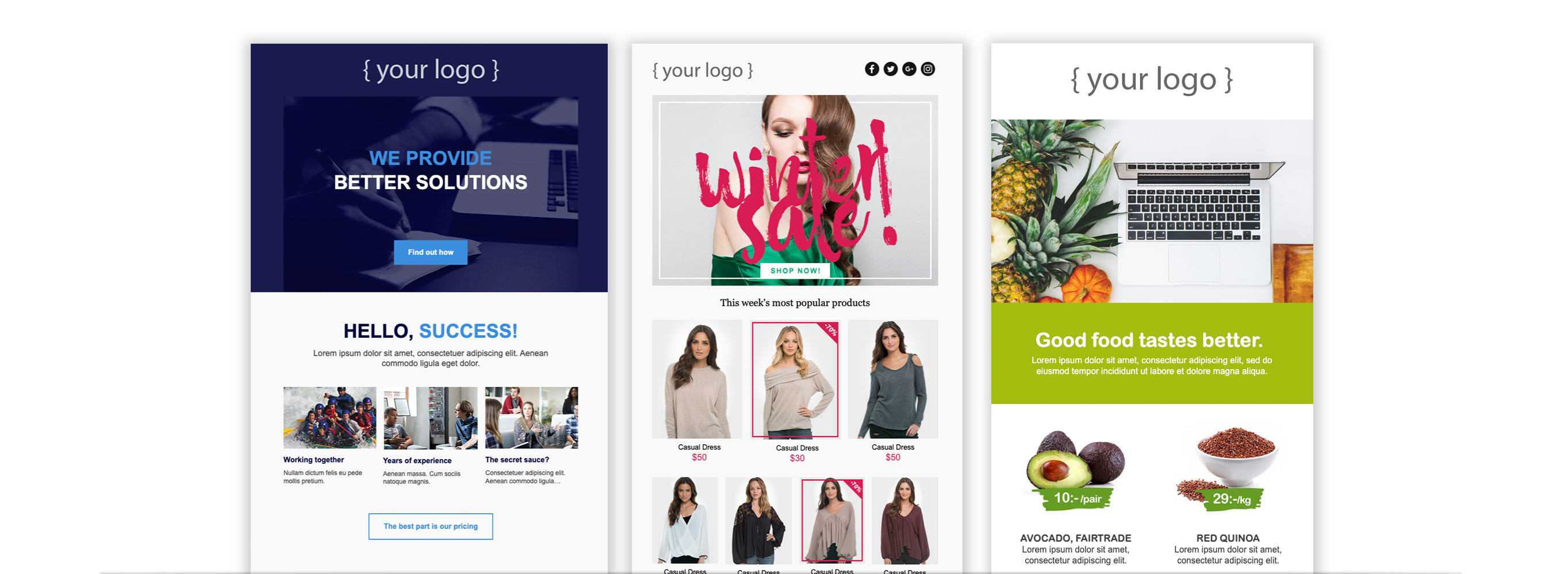
Use a tool that lets you create good-looking emails without code. Keep the design simple, mobile-friendly and recognizable in your brand identity.
Write a subject line that gets people to open
The subject line is the first, and often the only, thing the recipient sees. Personal, clear and curiosity-sparking. Avoid salesy phrasing and exclamation marks.
Segment and send
Don't always send to the whole list. Adapt to profession, location and previous behavior. We go through how to divide your list in the guide on segmentation.
Follow up and learn
Look at open rate, click rate and conversions. What worked, what fell flat? Use the insights next time.
Email marketing strategy
An effective email marketing strategy rests on three pillars:
1. A clear target audience. Who are you writing to? What do they want? The better you understand the recipient, the more relevant your emails become.
2. A relevant recipient list. Quality over quantity. A list of engaged subscribers who open and click is worth much more than a large list that ignores you.
3. Content that adds value. Every email should feel worth the recipient's time. The rule of thumb is that 80 to 90 percent of the content should be informative or inspiring, and 10 to 20 percent sales.
By combining regular newsletters, targeted campaigns and automated flows, you build communication that engages over time and drives measurable results.


Create engaging newsletters that get opened
Good newsletters are built from four parts: design, content, subject line and timing. Here is what actually works.
Professional and clear design
Keep it simple and airy. Clear sections, short texts and plenty of white space make it easy to take in.
Use images with care. Images reinforce the message, but too many load slowly and look cluttered.
Follow your brand identity. Colors, fonts and logo should be recognizable.
Think mobile-friendly. According to Litmus Email Analytics, 55 to 65 percent of all emails have been opened on mobile since 2020. The design has to work there first.
One clear CTA. Have a button or link that shows what you want the recipient to do next.
Relevant and balanced content
The recipient should get something out of reading. A common rule of thumb is 80 to 90 percent valuable content and 10 to 20 percent sales. It's about nurturing the relationship, not just landing the next deal.
Subject lines that catch attention
The subject line decides whether the email gets opened or disappears in the clutter. We have a separate guide with examples and testing methods for subject lines that get more people to open, but this almost always works:
- Make it personal. Include the recipient's name or something specific to them.
- Spark curiosity. A short question or a hint of something worth reading.
- Focus on the value. What does the recipient gain by opening?
- Keep it short. The optimal length is 30 to 50 characters, so that the whole subject line is visible on mobile.
- Avoid spam flags. Lots of exclamation marks, words like "free" or capital letters easily end up in the spam folder.
Build a strong list
It's about having the right recipients, not just many. Engagement should always come before size. And make sure you follow GDPR from the start – we go through what applies in the guide on what GDPR means for businesses.
Automation – save time and improve results
Automation means that certain emails are sent automatically at the right moment, based on the recipient's behavior. It saves time while making your communication more relevant. The most common automated flows:
- Welcome flow. Automatically sends an email when someone signs up, the first impression of your brand.
- Onboarding series. Helps new customers or subscribers get started step by step.
- Abandoned cart reminder. Recovers lost purchases in e-commerce.
- Birthday greeting. Personal contact with a small offer.
- Lead nurturing. Builds trust step by step before a buying decision.
- Re-engagement. Wins back subscribers who have lost interest.
Automated flows often get significantly higher open and click rates than regular emails, precisely because they are relevant to the recipient in the moment. If you are starting from scratch, the first email to new subscribers is what gives the most back per hour spent.
What's new in 2026: AI, hyper-personalization and new delivery requirements
In 2026, email marketing has changed on several levels. Here are the clearest shifts, and what they mean in practice.
1. AI-driven personalization is no longer a bonus
In 2025, AI-generated subject lines and product recommendations went mainstream. In 2026, they are expected. Recipients quickly tire of generic emails, and the platforms that let you tailor content per recipient, based on behavior, location and previous purchases, get clearly better results. That doesn't mean you have to build your own AI models. Most modern tools, including Paloma, have built-in features for varying content per recipient without manual work.
2. Stricter delivery requirements from Google, Apple and Microsoft
Since 2024, the big email providers (Gmail, Apple Mail, Outlook) have tightened their requirements on senders. For your emails to reach the inbox in 2026, you need:
- A DMARC policy configured on your domain
- SPF and DKIM set up correctly
- Clear unsubscribe, preferably with one click
- A low complaint rate, below 0.3 percent according to Google's sender guidelines for Gmail
- An engaged list, inactive recipients drag down your sender reputation
If you use an established tool, most of this is already taken care of. If you use your own email server or older solutions, it's time to review. We go through how to set up the record in your DNS and read the reports step by step in the guide on DMARC.
3. BIMI: your logo in the inbox
BIMI (Brand Indicators for Message Identification) displays your logo next to the sender address in Gmail, Apple Mail and more. It gives a professional impression and builds trust. It requires DMARC and a certified logo, but is worth the effort for businesses that send regularly.
4. Less focus on open rate, more on engagement
Since Apple launched Mail Privacy Protection in 2021, the open rate has become a less reliable KPI. In 2026, click rate, conversions and list growth are more important metrics.
5. Mobile first, for real
More than half of all emails are opened on mobile. Newsletters built for a desktop screen and then shrunk work worse than those designed for mobile from the start: one column, large buttons, short text above the fold. Modern tools with responsive templates solve most of this automatically, but always preview on mobile before you send.
GDPR and email marketing – how to get it right
Email marketing is built on trust, and GDPR sets the framework for that trust. For Swedish businesses, that means four basic requirements:
1. Active consent (opt-in). The recipient must have actively said yes, not been pre-ticked.
2. Clear unsubscribe. Every email must have a visible unsubscribe link that works with one click.
3. Secure handling. Personal data must be stored securely, preferably on servers within the EU.
4. A documented purpose. You must be able to show why the recipient is on your list and what they have consented to.
When you choose a tool, this is one of the most important things to look at. Paloma is built with GDPR at its core and stores all data on Swedish servers within the EU. Whatever the tool, as the sender it is your responsibility to follow the rules. We go through how to get consent right in the guide on GDPR and newsletters.
Common mistakes to avoid
Even experienced marketers make mistakes. Here are the most common pitfalls in email marketing, and how to avoid them:
The same message to everyone. Identical emails to the whole list give low engagement. Segment instead – even simple segments like "customers" and "prospects" make a big difference.
Lack of testing. The email might look good in your browser, but what does it look like on mobile and in different email clients? Always send a test to yourself first.
Unclear calls to action. If the recipient doesn't know what to do, nothing happens. Use clear, clickable buttons with a concrete call to action.
Sending too often. Bombarding your recipients is a sure path to unsubscribes. Find a balance, and preferably let the recipients choose the frequency themselves.
Not cleaning the list. Inactive recipients drag down your deliverability. Remove or re-engage those who haven't engaged in 6 to 12 months.
Not measuring. Without follow-up, you don't know what works. Statistics are your best friend.
Sending without a clear purpose. Every email should have a goal: traffic, sign-ups, sales, brand presence. "Just sending something" rarely leads anywhere.
Tip: many of these mistakes disappear with a good tool. A platform like Paloma helps you with segmentation, testing, automatic list management and follow-up, so that you can focus on the content.
Measure the right things – KPIs for email marketing
To improve your emails, you need to know what works. Here are the KPIs that actually tell you something:
Deliverability. The share of emails that actually reach the inbox. Should be above 98 percent.
Open rate. The share of recipients who open the email. According to Mailchimp's industry statistics, the average is about 21 percent, with large variations by industry, from about 14 percent in retail to over 40 percent in legal and government. Less reliable since 2021 because of Apple Mail's tracking protection.
Click rate (CTR). The share of recipients who click a link. According to Mailchimp's industry statistics, the average is 2 to 5 percent depending on the industry.
Conversion rate. The share who do what you want (buy, sign up, register). This is the most important KPI.
Unsubscribe rate. Should be below 0.5 percent. If it rises, something in the content or frequency isn't right.
Complaint rate. How many mark you as spam. Should be below 0.3 percent according to Google's guidelines; above that, you risk delivery problems.
List growth. How fast is your list growing? Count unsubscribes too, to see the net growth.
In Paloma, you find all these KPIs per email, which makes it easy to see what works and what needs improving. If deliverability is below 98 percent, that's the number to start with, not the content. The causes and fixes are gathered in the guide on newsletter deliverability.
Checklist before you send
Use this list every time, before you click "send":
- Is the subject line clear, enticing and under 50 characters?
- Have you tested the email on both mobile and desktop?
- Is there a clear and clickable CTA?
- Is the email going to the right segment of recipients?
- Does the email include the sender, contact information and an unsubscribe link?
- Have you read through the text one last time, for typos and broken links?
- Is the send time adapted to the target audience (B2B recipients most often open on weekdays between 9 and 11 am)?
- Have you set a goal for the email so that you know what to measure?
Email marketing tools in Sweden
The most common email marketing tools among Swedish businesses and organizations are Paloma, Rule, Ungapped, Get a Newsletter and Mailchimp. Four of them are Swedish and offer support in Swedish. Brevo and MailerLite are two international alternatives with large free tiers. What sets them apart is mainly where your data is stored, which channels are included besides email and whether there is a free tier to start with.
| Tool | Origin | Data storage | More than email | Free tier |
|---|---|---|---|---|
| Paloma | Swedish, since 2003 | Sweden | SMS, events and automation | Yes, 250 emails a month |
| Rule | Swedish | Within the EU | SMS and automation | Yes |
| Ungapped | Swedish | Sweden | SMS, events, surveys and automation | No |
| Get a Newsletter | Swedish | Sweden | SMS and basic automation | Yes |
| Mailchimp | American | USA | Automation, SMS and surveys depending on the plan | Yes |
| Brevo | French | Within the EU | SMS, purchased separately | Yes, 300 emails a day |
| MailerLite | International | Within the EU | Forms and landing pages | Yes, 2,500 emails a month |
Paloma suits you if you want newsletters, SMS and events in the same tool, with data in Sweden and personal support by phone and email. If you want to see how the tools compare in detail, read our comparison of seven newsletter tools.
If you are thinking about switching from Mailchimp, there is a separate guide on alternatives to Mailchimp. And if the tool needs to talk to your CRM or your website, you can read about integrations and API in Paloma.
Use Paloma to grow
Paloma is built for Swedish businesses, associations and organizations that want to make email marketing simple, warm and close. You create good-looking newsletters yourself, manage lists automatically and get clear statistics on everything you send. Personal support is always close at hand if you need help.
The free account includes 250 emails a month with an unlimited number of contacts, with no card and no lock-in period. The paid plans start at 95 SEK a month. All data is stored on Swedish servers. Create an account, import your list and send your first email the same day.
"We use Paloma a lot in our business. Super easy to understand, with unbeatable support. We are very happy!"
Frequently asked questions
What is email marketing?
Email marketing is a form of digital marketing where businesses send emails to a list of recipients to build relationships, share news, drive sales or remind customers about products and services. It is one of the most cost-effective channels for businesses that want to reach their target audience directly in the inbox.
How does email marketing work?
Email marketing works in five steps: first, you collect email addresses through your website with the recipient's consent. Then you create an email in an email marketing tool, choose the right target audience through segmentation, and send the email. Finally, you follow up on the results by analyzing the open rate, clicks and conversions.
How can I send newsletters for free?
Several tools have free plans for smaller lists. Paloma's free account includes 250 emails a month with an unlimited number of contacts, with no card and no lock-in period. That is enough for a monthly newsletter for a small association or a new business. If you need to send more, the paid plans start at 95 SEK a month.
How do I create good-looking newsletters on mobile?
Start from a responsive template in your tool, and the layout adapts automatically to the screen. Use one column, large clickable buttons and short paragraphs, and put the most important things at the top. Always preview on mobile before you send – more than half of all emails are opened there.
How do you do digital marketing?
Digital marketing is about reaching customers through digital channels such as email, social media, search engines and websites. Email marketing is one of the most established channels because it gives you direct contact with the recipient and is easy to measure. A good digital marketing strategy combines several channels and adapts the message to where the recipient is in the customer journey.
Is email marketing GDPR-compliant?
Yes, email marketing is GDPR-compliant if the recipients have given their consent (opt-in), if there is a simple unsubscribe link in every email and if personal data is handled securely on servers within the EU. When you choose a tool, check where the data is stored. Paloma uses Swedish servers.
What does email marketing cost?
The cost varies with the tool and the size of the list. Most platforms have free plans for smaller lists. Paloma has a free account with 250 emails a month, and paid plans from 95 SEK a month. For larger lists and advanced features such as automation and segmentation, Swedish small and medium-sized businesses usually pay around 200 to 2,000 SEK a month.
How often should you send newsletters?
There is no universal rule, but a common guideline is 1 to 4 emails a month. The important thing is to keep a steady rhythm and that every email adds value. Better one good newsletter a month than four that the recipient ignores. Preferably let the recipients choose the frequency themselves when they subscribe.
What is the difference between newsletters and email marketing?
Newsletters are a type of email marketing, but not the only one. Email marketing is the umbrella term and also includes campaign emails, automated flows, welcome emails and reminders. Newsletters are often the recurring part of an email strategy.
What is the best email marketing tool in 2026?
It depends on your needs. For Swedish small and medium-sized businesses that want simple management, GDPR compliance and personal support, Paloma is a good choice. For larger companies with complex needs, international tools such as Mailchimp, Klaviyo or HubSpot may be relevant. The important thing is that the tool fits your size, your skills and where your customers are.
Which email marketing tools are there in Sweden?
Among Swedish businesses and organizations, Paloma, Rule, Ungapped, Get a Newsletter and Mailchimp are common choices. Paloma, Rule, Ungapped and Get a Newsletter are Swedish and offer support in Swedish. Paloma stores data in Sweden and brings newsletters, SMS, events and surveys together in the same tool, with a free account for up to 250 emails a month.
Try email marketing with Paloma
Create your first newsletter in minutes. The free account gives you 250 emails a month with an unlimited number of contacts.
Create a free accountThis guide to email marketing covers what the channel is, why it works, different types of email, how to create an email step by step, strategy, design and subject lines, automation, what's new in 2026 (AI, DMARC, BIMI), GDPR, common mistakes, KPIs and a checklist before you send. You'll find in-depth guides on subject lines, segmentation, welcome emails, DMARC and deliverability among our guides.