What is inbound marketing – and how can you use it in your marketing?
Inbound marketing is a method where you attract customers with content they are already searching for, instead of interrupting them with advertising. You show up when the customer is looking for answers, build trust with helpful content and let the customer take the next step on their own.
If you work in marketing and communications, you have probably heard of inbound marketing in some context. But what does it actually mean? And how can you use this marketing method to increase your sales? If there is one thing to remember about inbound marketing, it is that it is the opposite of outbound marketing. Inbound marketing means that instead of seeking out customers with your message, you let customers come to you. Whether you work in B2B or B2C, whether your company sells products or services, and whatever your target audiences look like, inbound marketing is a communication and marketing tool that is here to stay.

Contents
- Inbound or outbound?
- Methods and activities
- Leave digital breadcrumbs
- Inbound for B2B
- Create warm leads
- Awareness
- Consideration
- Purchase decision
- Loyal customer
- Be present
- Personalize your content
- Find your buyer personas
- Ask the right questions
- Invest in the right channels
- Communicate on the customer's terms
- Combine different techniques
- Six reasons
- 7 steps to get started
- Frequently asked questions
What is the difference between inbound and outbound?
Outbound – seeking out potential customers
- Actively reaching out: This strategy involves active attempts to reach potential customers, usually through communication that interrupts them.
- Traditional methods: Outbound marketing can include techniques such as TV and radio advertising, direct mail (e.g. brochures, postcards), cold calling, mass email campaigns and banner ads on websites.
- The goal is to spread the message about a product or service to as many people as possible, in the hope that some of them will be interested.
Inbound – letting potential customers come to you
- Attracting: Instead of actively seeking out customers, you set out to attract them to the company by creating valuable content and experiences tailored to them.
- Content-focused: Inbound strategies often involve blog posts, SEO (search engine optimization), social media, e-books, webinars and other methods that use online content to draw potential customers to a website or a platform.
- The goal is to be where potential customers already are, provide value, build relationships and engage them until they are ready to make a purchase.
Inbound combines different methods and marketing activities
One advantage of inbound marketing as a marketing method is that you combine different digital marketing activities and channels. In other words, it does not rely on an isolated strategy. You work with marketing automation and data analysis as well as content and marketing in different channels. That way, customers can easily find you when they need to – and you can follow the entire customer journey, step by step.
Leave digital breadcrumbs
Okay, that sounds reasonable, you might be thinking. But how does it work? Basically, it is about giving customers what they want, when they need it. Say you sell jackets, for example. You know that jacket season is coming up and that your customers will soon start researching their winter purchases. You also know that not all jackets are created equal – and that your customers need guidance to find their way through the Gore-Tex jungle.
So you put together a guide that clearly explains the difference between waterproofing and DWR, why some materials breathe better than others and how best to care for your new outerwear. And you complement the guide with solid SEO work, a short explainer video to share on social media and a chat function on your website. In other words, when your customers are ready to start looking, you are right there with exactly the information they want.
Get closer to your B2B customers with inbound marketing
And of course inbound marketing applies just as much if you work in B2B, even if it might be about helping prospective customers understand the basics of payroll administration or explaining the production process for petroleum coke, rather than selling jackets. But in many ways the goal is the same – using digital material to establish your company as one that offers useful knowledge your customer group needs. So that, in the long run, you end up top of mind when the customer is looking for your type of product or service.
B2B marketing is also often characterized by complex considerations and big decisions, which of course only makes inbound marketing even more interesting. Because the customer journey matters just as much, no matter who your customers are.
Create warm leads
When you work with inbound marketing, you focus primarily on visibility, while outbound marketing focuses on contact. In many ways, as is so often the case, it is about the customer journey. Compare your own buying behavior with what it looked like just a few years ago. Do you do more or less research before a purchase today? Our educated guess is that you would say the former. And that, of course, is exactly what inbound marketing is built on.
When a potential customer clicks your link and wants to read more about whether they should go for a nylon or a polyester jacket, that person is not only ready to buy, they have made their way through the customer journey on their own terms. Unlike someone who has only seen your TV commercial, this customer counts as a “warm” lead.
Navigate the customer journey with inbound marketing
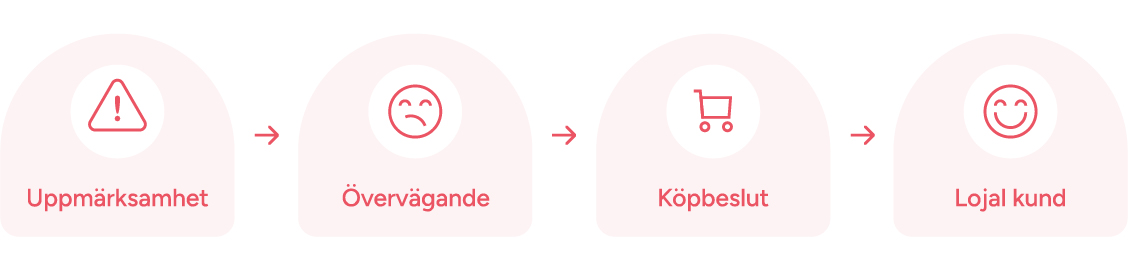
When we talk about the famous customer journey, we like to describe it as a journey with four different stops: awareness, consideration, purchase decision and loyal customer.
Awareness
In the first step, you need to get your potential customers to notice you and what you offer. In other words, you need to make sure you are visible when they realize what they need help with. Good SEO work lays a solid foundation and puts you high up in the search results.
Consideration
Next comes the phase where your potential customer considers whether your product or service is right for their business. You need to build trust and become a credible source of knowledge. This is very much about creating good content that in turn can create value. And make sure to package it nicely – the nicer the wrapping paper on your inbound marketing, the greater the chance that someone will want to open it.
Purchase decision
Now it is time to make a decision, and of course you want to be top of mind with the customer. A nice surface is not enough – take the time to produce useful, helpful content. Ideally combined with marketing automation efforts, so that you remind them that you exist.
Loyal customer
The purchase is done and the customer is yours! But now it is about staying in the customer's mind. Relevant and preferably personalized content is the key to loyalty. After all, you want to create a “need for more”!
Be present
Something worth keeping in mind when you start producing content is that these days it is not enough to just exist on social media. If you want your customers, suppliers and others in the industry to like you, you need to be a bit active. Talk, highlight your great content and point people in the right direction. Of course you cannot control what others say about your company, but you can do your best to show the way.
Personalize your content
This is also the right way to go to build stronger relationships with your existing customers. When you position yourself as a source of valuable knowledge with your finger on the pulse, you encourage them to come back to you. By also working with personalized content, you can create strong engagement around your inbound marketing. Think personalized email campaigns, think social media, think niche campaign pages. Create content that opens doors and lets you keep the conversation going.
Find your buyer personas
But how do you know how to tailor your content? Who is the person on the other side of the screen? To really hit the mark in your email campaigns, LinkedIn posts and campaign pages, we recommend creating a so-called buyer persona. The clearer the picture you have of the person you are talking to, the easier it is to talk about the right things.
Buyer personas are often a combination of thorough research and experience. Run surveys, collect statistics and read reports, but also talk to others in the organization. It is not unusual for this kind of task to land on the marketing department's desk, but that is not always where the knowledge about your customers is greatest. To succeed with inbound marketing in B2B, communication across your internal boundaries is super important. So talk to each other, make use of what you already know and get to know your customers as well as you possibly can.
Ask the right questions
The foundation of a good persona is of course your strategy and your goals. It is a good idea to set up one persona for your existing customers and one for potential customers. From this foundation, you can draw conclusions about what their problems look like, what they are looking for and how they navigate their search for information. Based on this, you can adjust and tailor your content so that it meets their needs at every step of the journey.
Invest in the right channels
As you can imagine, some channels and activities are more associated with inbound marketing and others with outbound marketing. Here is what a tasty channel buffet can look like across the inbound versus outbound spectrum.
Communicate on the customer's terms
The biggest, and perhaps most obvious, advantage of inbound marketing is of course that it is about communication on the customer's terms. Once again, look at what you prefer yourself: getting well-packaged information when you need it and ask for it, or being interrupted by an unprompted message when you least expect it.
If outbound marketing is the pushy salesperson who taps you on the shoulder when you are just window shopping, inbound marketing is the helpful shop assistant who knows the business inside and out. In other words, you might not even think of inbound marketing as sales at all, but rather as education or entertainment.
Combine different techniques with your inbound marketing
In an inbound marketing context, your potential customer already has an interest in the product; they may even have been in contact with your company before. Outbound marketing is more of a shot in the dark, since the recipient may not even know you exist. That said, outbound marketing efforts do not have to be wasted. One does not have to exclude the other – quite the opposite. Combining two different marketing techniques is often the very best approach.

Six reasons to use inbound marketing
- You build trust by sharing knowledge and tips for free, which makes it more likely that someone will choose you.
- Because the customer is actively looking for what you offer, conversion rates are higher and you save both time and money.
- Because the material often stays on your website, customers can keep finding it today, tomorrow and the day after without you having to do much.
- Most buying processes today start with a Google search, which is why good material and keyword optimization can take you a long way.
- Inbound marketing is often cheaper than outbound, as long as you have the basics in place.
- If you work with the right tools, you easily get concrete, measurable results that help you optimize your communication.
7 steps to get started with inbound marketing
Set your strategy and goals
Start at the beginning and do it properly! With a well-thought-out, carefully developed strategy, you have something to lean on throughout your inbound marketing process. And put it in writing so that everyone involved knows what it is. The goals are of course also an important part of the strategy – after all, they are what you are aiming for. One tip is to take a look at the classic SMART method, which can offer some guidance in the process.
Specific – Setting clear goals can be tricky, but you will thank yourself for doing it in the end.
Measurable – Quantitative goals are of course easier to measure, but there are methods for checking qualitative goals too. Just remember to take a baseline measurement first, so that you have a starting point to compare against.
Agreed – Just as with the strategy, it is important that everyone involved knows the goals. The better everyone knows them, the easier it is to work in the same direction.
Realistic – Unlike a vision, your goals should be possible to reach. That matters both for motivation and for being able to set the right strategies.
Time-bound – Test, measure, evaluate, test again. With a reasonable time frame, the goals become more relevant and easier to analyze.
Find your personas
The process of settling on your buyer personas can go hand in hand with developing your strategy and goals. So now is the time to book a workshop with the customer service team and the sales department and put your heads together. What challenges do your customers have that make them look for information? What do they need? And how do they make decisions?
Find good keywords
Now use your newfound personas to build a list of relevant keywords. What questions do the salespeople usually get? What words and terms do customers use? Because that is what matters most – not what the technically “correct” term is.
One tip is to check the list against Google Keyword Planner and Google Trends. These tools can help you see how many people google your particular words, what it would cost to advertise on these keywords via Google Ads and how high you can rank in the customer's search results. Some keywords have particularly high competition and are therefore expensive, while you can get others cheaply because fewer people search for them.
Plan your content
By making a plan for your content, you can make sure you have a good spread across different channels and that you reach the right people with the right message. In the planning phase, this might mean developing a content calendar for your social channels where you specify what you will highlight, on which platform and when. It is also time to set up ad accounts linked to your social channels, if you do not already have them.
Produce relevant content
This step is perhaps the most time-consuming, but in many ways also the most rewarding. This is when you get to see your ideas and strategies come to life! It might mean producing guides (like the one you are reading right now), blog articles and white papers for your well-designed website, while you develop social media campaigns that drive the traffic. If you play your content cards right, you can turn a cold lead warm. To see what really works best, you should also A/B test your posts and campaigns along the way.
Convert your leads
Marketing automation is perhaps the very best way to move your leads from one stop on the customer journey to the next. By building up a bank of relevant emails, you can create an automated flow that pushes your customers from the consideration phase to the purchase decision. But how do you do that? How do you create something that feels urgent enough for the person on the other side of the screen to sit up and take notice? Start by thinking of each email as an answer.
Think about which questions your salespeople usually get, and answer them. To begin with, you can work through the ones salespeople get during the first meeting, and then in the next step address questions about how you can solve their problems. The emails then work both as a way to clear up any question marks before they have even been put into words, and as a reminder that you have the solution to the problem.
Analyze, evaluate and optimize
It is easy to skip this step. After all, you have already been thinking and testing throughout this whole inbound marketing process. But trust us, when it comes to data, you can hardly evaluate it too much. There are always parts to optimize. Is this post doing the right job? Do these keywords help the customer find the right thing? Does this email answer all the questions?
Frequently asked questions about inbound marketing
What does inbound marketing mean?
Inbound marketing is a method where you attract customers with content they are already searching for, instead of interrupting them with advertising. You show up when the customer is looking for answers, build trust with helpful content and let the customer take the next step on their own.
What is the difference between inbound and outbound?
Outbound means that you seek out the customer, for example with ads, cold calls or mailings to purchased lists. Inbound means that the customer finds you through search, content and recommendations and chooses to get in touch or subscribe.
What phases does inbound marketing include?
The work follows the four phases of the customer journey: awareness, consideration, purchase decision and loyal customer. In each phase the customer needs different content, from guides and blog posts to customer case studies and follow-up.
What are some examples of inbound marketing?
Common examples are guides and blog posts that answer the customer's questions, search engine optimization, newsletters that recipients have signed up for themselves, webinars and checklists to download.
Is inbound marketing suitable for B2B?
Yes. In B2B the buying journey is often long and several people are involved in the decision. Content that helps them understand their problem and compare solutions builds trust long before the first sales call.
What tools do you need for inbound marketing?
You need a website with good content, a way to collect contacts with consent and a tool for newsletters and automated flows. In Paloma you bring together newsletters, SMS, events and automation, and you can start with a free account.
Taking inbound further in your marketing
We know, it is a lot to think about. Hopefully you have still found answers to some of your questions, but if you have any thoughts at all on how you should take your inbound marketing further – let us know.
Contact us at Paloma, we are happy to help you with inbound marketing!
More guidance on marketing:
The digital customer journey

Get started with Paloma
Create your first newsletter in minutes. The free account gives you 250 emails a month with an unlimited number of contacts.
Create a free account