
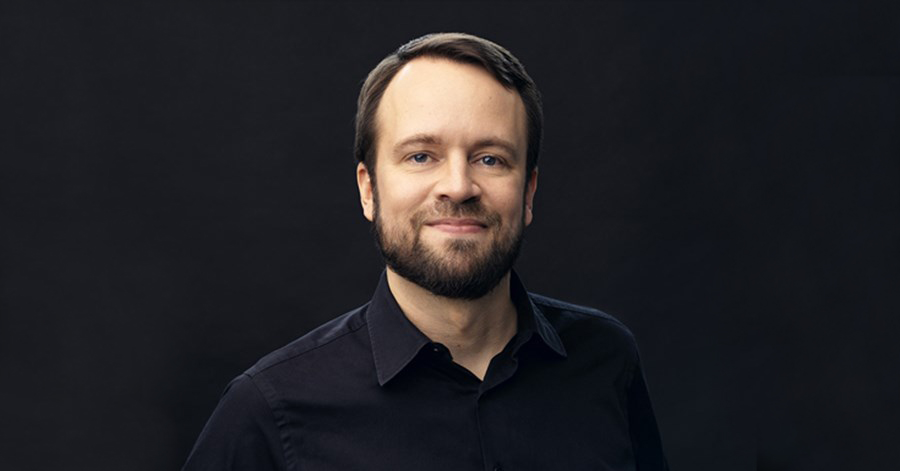
Mattias Ribbing on brain-smart networking at events
Mattias Ribbing is a three-time Swedish memory champion. As a teacher, he has always been fascinated by the brain and brain training. Today he works to spread knowledge and raise awareness that it is actually possible to train up and learn to cooperate with your brain, with astonishing results. By knowing the smartest strategies and getting used to using them, we can change the way we use and work with our brains.
The basis for thinking more effectively is thinking in pictures. Then the brain works much more smoothly, and we can take in much more information; information that becomes our own.
– Training yourself to consciously think in pictures is like always having a notepad at hand. As soon as you consciously start learning names and faces, it works like a magnet; you will automatically remember other things better. What you talked about, where and when you met, and so on. You get many positive side effects when you push the brain in the right direction, says Mattias.
Visualization is the key
Thinking in pictures can feel hard and unclear. Then you should be aware that it is something vague, it does not look like what we see with our eyes, and that is completely okay. Even if it is a vague picture that flickers by, it is enough for the brain.
– It is unclear for everyone, including me, who has trained this. But it works anyway, that is what is so cool.
Thinking in pictures is like giving the brain folders on a computer. Without a strategy, it is as if we threw a lot of documents onto the computer without names or places. They are there on the hard drive, but you will never find the right document just when you need it.
Relief for the brain
– Trusting my memory gives me the freedom to let go of things for the moment; I do not need to cling to them. Thanks to that, the brain does not get stressed, but is relieved instead.
In the same way as when we learn to write letters, the process becomes more and more automatic once we get going with visualizing. He describes it as writing directly in the brain instead of on paper, with a new alphabet consisting of pictures we recognize.
– You never need to think about how to write something down; you decide what to write and do it. It is the same for me: I choose what I want to store and note it down in my brain. I quickly imagine the pictures needed, then it is done and I can trust that it sticks.
Myths about memory
A person may be said to have a good memory for faces, to find names easy or hard, or to be hopeless when it comes to numbers. Memory is often perceived and described as something you are either gifted with or not. Many people are therefore limited by a negative self-image.
There are of course innate variations, but a working strategy and brain-smart training make a much bigger difference, according to Mattias. Your starting point when it comes to remembering numbers, names and faces does not matter once you have gained control over your ability to take in information.
– I did not have impressive grades or any special abilities. I was like anyone else when I started training at the age of 28, which the people who know me are aware of. From being just anyone, I have gone to being able to memorize a thousand digits today.
There is hope even when memory deteriorates. An example that illustrates this is the martial artist whose memory had been written off after many blows to the head, but who did not want to give up. After coaching online, he has beaten Mattias's personal best and astounded the psychologist who carried out a follow-up test.
Memory training is for everyone
We are more alike than we think; our brains are not completely different organs, and we do not learn in completely different ways. It does not matter that we have different experiences, likes and dislikes; in how they function, our brains are alike. Thinking in pictures helps everyone and can take everyone to the next level. Something that becomes particularly clear in school. There you get a direction that works for everyone, where concrete results show early with the first steps.
– With neuropsychiatric diagnoses, and if you are recovering from burnout or depression, this type of strategy is in a way even more important, since it relieves the brain.
It is an inclusive message that Mattias conveys, and an opportunity to replace powerlessness with drive.
Three brain-smart steps
A common beginner's mistake is wanting to learn to remember everything right away. Training your memory step by step is a more constructive approach. In addition, each of these steps works like a magnet, as automatic connections help you remember related information.
You can apply these three steps at different kinds of events. Try step one, practice and discover how you get a better overview and can feel more relaxed in your interaction with the people you meet. Practice steps two and three both in spontaneous conversations and when creating a presentation. Notice how it becomes easier both to keep your thread and to make your message stick with others.
Step 1: First names and pictures
Start by getting a strategy for first names. When you greet a person, first of all double-check that you heard correctly by repeating the name out loud. Then turn the first name into a picture. Take the first one that comes to mind.
Some examples (from Swedish):
Marie – Marie biscuit
Linda – a bandaged ("lindad") arm
Lars – garage door
Mohammed – boxing glove.
If the first thing that comes to mind is a rhyme, that is okay, but it is not enough to think Jan Banan; you have to visualize a banana too. You need to actually see the picture in front of you in the room.
Enlarge the inner pictures – do not visualize a Marie biscuit in its natural size; make it jumbo-sized and three-dimensional.
Place the picture in front of the person, or on their shoulder. Seeing the person and the object together creates a connection between them in the brain. Remember that it works even if the picture is vague.
Step 2: Paint a scenario or picture
Paint a scenario or a picture to create connections for the listener. With the help of pictures, we can unpack and find our way back to what we talked about.
If you have sat listening to something for two hours that is then completely gone, the speaker has not succeeded in creating connections. Without connections to something familiar, new information becomes an island – an island that, even if it was interesting to visit, is very hard to find your way back to.
Step 3: Start with the big picture
It is important to start with the big picture and in that way create a skeleton of knowledge so that the details have something to attach to. It is when you go into details that people cannot connect to anything that they zone out.
The big picture opens the gates to attention and understanding. That applies whether you are explaining something from the stage, in a business meeting or in a conversation with old and new acquaintances.
Commitment to his own and others' learning
He is curious about the brain, deeply interested in teaching and loves learning new things. Mattias was working as a teacher when thoughts about how to train the learning muscle in a smarter way drove him to memory training. Since his first book Vägen till mästarminne (2012), he has largely devoted himself to lectures and workshops on the subject.
To examine how the strategies can be adapted for school, he followed an upper secondary class and a lower secondary class for a period. It resulted in Vägen till maxade betyg (2014), a practical book that encourages thinking in a smarter and more fun way. Mattias keeps getting appreciative emails from teachers, students and parents who testify to how amazing it is to get results.
Mattias Ribbing wrote the book Fatta matte (2017) together with the mathematician Per Sundin. It is about understanding mathematics in a lively and playful way.
– That is how we learn. All children are experts at learning before they start school, because then play is the foundation.
From simple arithmetic rules all the way to advanced upper secondary math, Fatta matte focuses on parts that many find hard. The book is used by school students and parents, but also by adults who want to fill in gaps.
Other books written by Mattias: Smart föräldraskap (2019) and Skärmsmart (2022).